
A lightweight and fast-shifting groupset, aerodynamic wheels and a streamlined and adjustable cockpit all bring out your bike’s best performance. When it comes to the person on board, however, a power meter is the optimum way to improve.
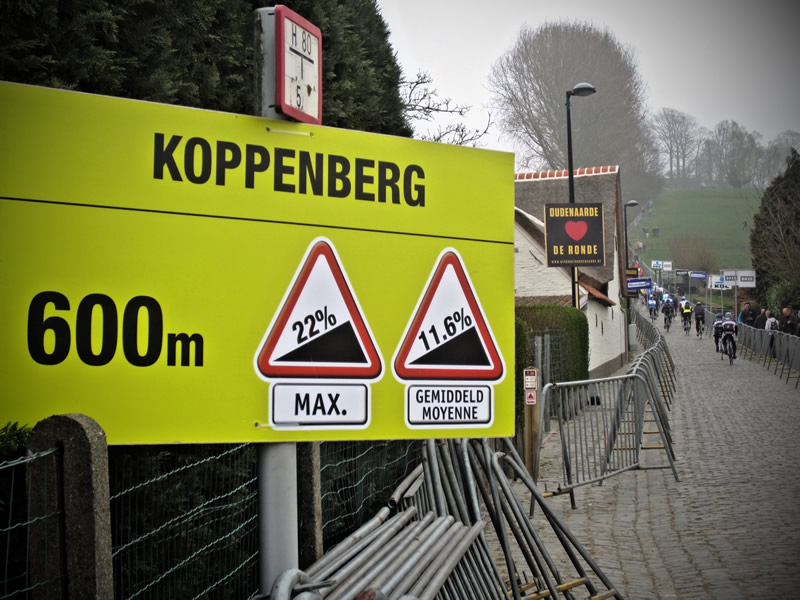
Two weeks’ ago in Belgium, The Road Diaries combined a throng of race-bound journalists and the SRAM RED-2012 groupset with optional Quarq power meter for a one day assessment of journalistic cycling ability. And what better test than the 138km Tour of Flanders cyclosportive, with its 16 hellingen including the famous Koppenberg, Oude Kwaremont and Patterberg.
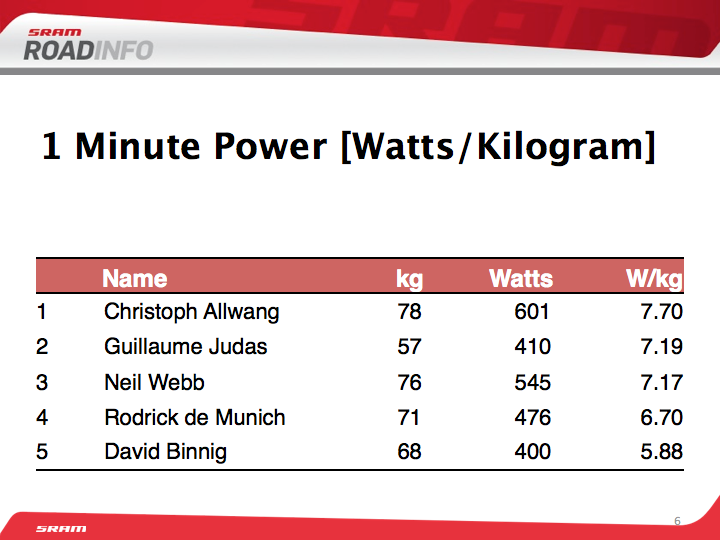
The assessment looked at 1-minute, 5-minute and 20-minute maximum power, ranked by power-to-weight. A further benefit of power data - sharing and comparing - also played a part. Following the ‘sportive, when everyone was truly exhausted, we sat them down and projected hard data about their performances onto a wall. And pitted them against each other. And listened to the excuses!
Four main energy systems are used in cycling - neuromuscular power, anaerobic capacity, maximal oxygen uptake (VO2max), and lactate threshold (LT) - and these can be evaluated by recording all out efforts over the following durations using a power meter:
Neuromuscular Power: 5 Seconds.
Anaerobic Capacity: 1 Minute.
Maximal Oxygen Uptake (V02max): 5 Minutes.
Lactate Threshold: 20+ Minutes.
With this information you can compare yourself to known benchmarks and assess your strengths and weaknesses. In turn you can choose race tactics and course profiles based on your strengths, or change your training to address your weaknesses.
Our analysis first looked at riders’ 1-minute power. SRAM’s European Technical PR representative, Christoph Allwang, topped the chart on both outright power and watts/kilogram. His 1-minute best of 600 watts is something this author has only dreamt about.
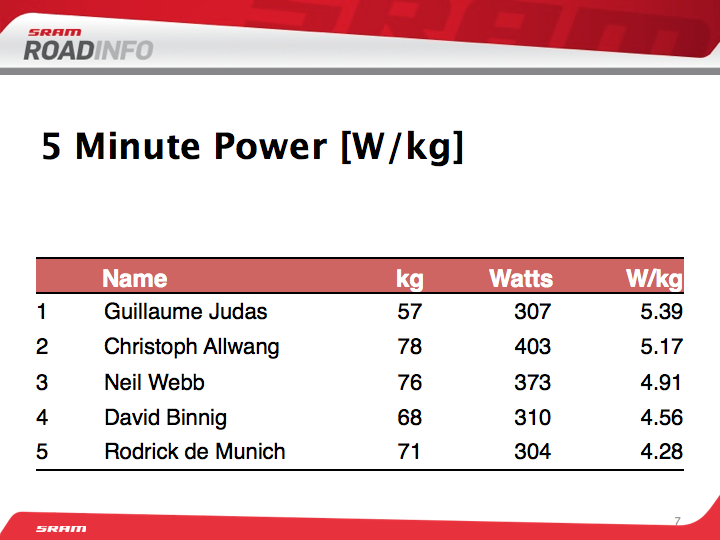
Guillaume Judas from France’s Cyclo Passion topped the 5-minute and 20-minute W/kg rankings. And we learnt after the ‘sportive he was holding back because he had to race the next day!
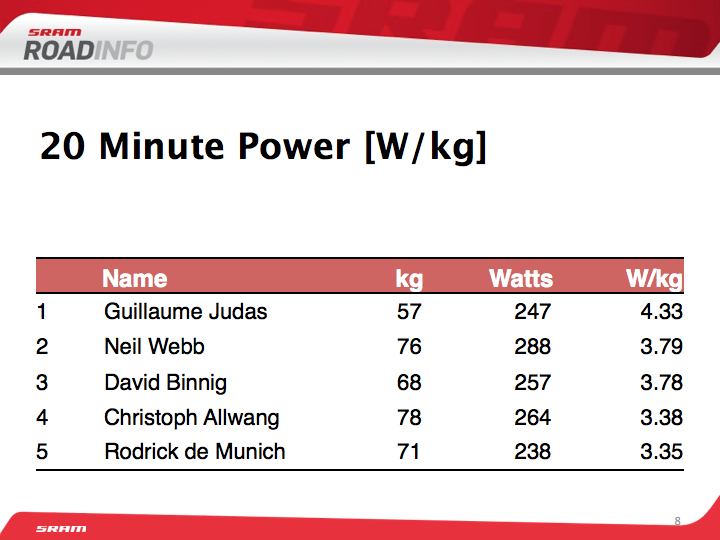
Guillaume’s effort deserves deeper analysis. By plotting his power profile we can see his aerobic ability approaches that of a Cat 1 racer. The upwardly sloping profile indicates he is an adept time trialist with good, sustainable power.
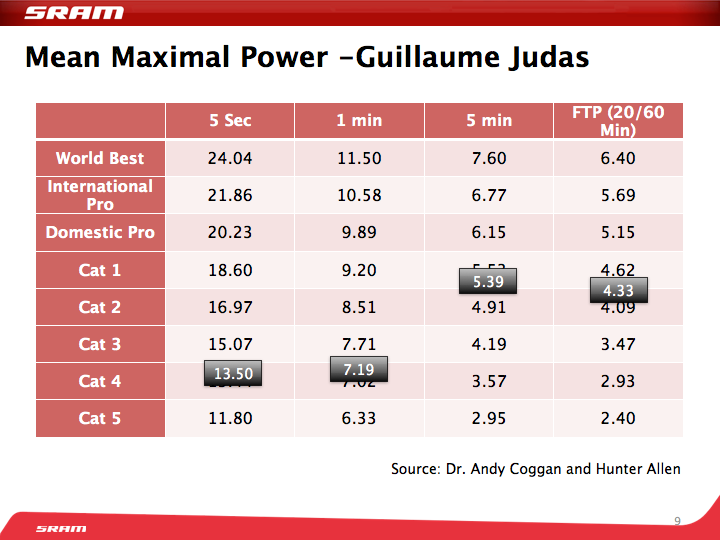
At 57kg (125lbs) and with a big aerobic engine, Guillaume is actually an accomplished climber and road racer. If we sent him out for a dedicated 1-minute effort, we’re certain the profile would become nearly horizontal, showing Guillaume to be an all rounder and competitive across a broad range of events.
We have no doubt sending Guillaume out for dedicated efforts across all durations would see numbers comparable to professionals. Guillaume’s calculated functional threshold power (FTP) in this event was 233 watts. His actual FTP, confirmed in training and races, is closer to 280 watts. He is fast! Neil Webb from Cycling Weekly (UK) bested everyone else and was a clear second place finisher on the day.
The power profiling technique we used can be found in the book, Training And Racing With A Power Meter. For more information on power profiling and assessing your strengths and weaknesses, grab a copy or see Power Profiling on the Training Peaks web site.
We would like to extend a special thanks to everyone who participated and made this exciting event and analysis possible.